If you’ve searched “laser therapy cost” and found a confusing mix of results — some about back pain, some about skin treatments, some about hair removal — you’re not alone. “Laser therapy” covers a wide range of procedures. Cost varies enormously depending on which one you actually need.
For pain relief in the joints, spine, or muscles, the price isn’t a single number you can look up online. It depends on which type of laser treatment fits your condition, how many sessions you need, and how your case is documented for insurance. A generic price list — the kind most search results show — usually mixes together costs for skin resurfacing, hair removal, and eye surgery alongside genuine pain-relief treatments. That’s exactly why the numbers you find rarely match what you’re actually facing.
This guide breaks down what genuinely affects the cost of laser therapy for pain, without guessing at a rupee figure that may not apply to your specific case. It also explains the insurance question most patients ask before they even get to cost: whether their policy will help cover it at all.
What “Laser Therapy” Actually Means for Pain
Before cost makes sense, it helps to know there are two very different treatments both called “laser therapy” in orthopaedic care:
- Surface laser therapy (sometimes called Low-Level Laser Therapy, or a higher-powered Class IV laser): A non-invasive session where a laser device is passed over the skin to reduce inflammation and pain — commonly used for arthritis, tendon pain, and muscle strain. This is billed per session, similar to a physiotherapy visit.
- PLDD (Percutaneous Laser Disc Decompression): A day-care procedure for a herniated or bulging disc, where a laser fibre is guided into the disc under imaging to relieve pressure on a nerve. This is billed as a procedure, with anaesthesia, imaging, and a short hospital stay factored in.
These two are priced completely differently because they’re structurally different kinds of care. One is an outpatient session; the other is a day-care medical procedure. Confusing the two is one reason patients can get an inaccurate cost expectation before their first consultation — a price you found for “laser therapy” online may describe neither treatment you actually need.
It’s also worth knowing that a large share of general search results for “laser therapy” describe cosmetic and skin treatments — hair removal, pigmentation, resurfacing. These have nothing to do with pain relief and are priced on a completely different basis. If a search result’s pricing doesn’t mention your condition or treatment type, it may not be relevant to your case.
What Determines Laser Therapy Cost for Pain?
1. Which Treatment Family You Need
This is the single biggest driver. A course of surface laser sessions and a one-time PLDD procedure sit in entirely different cost categories, because they involve different equipment, time, and clinical setup. Your doctor determines which one applies to your condition during your first consultation — it isn’t a choice you make based on price alone.
2. Number of Sessions
Surface laser therapy is rarely a single visit. Most pain conditions need a short course of sessions spread over a few weeks to get lasting benefit, so the total cost reflects the full course, not one session’s price. PLDD, by contrast, is typically a single procedure per affected disc level.
3. Diagnostic Imaging
PLDD requires an MRI beforehand to confirm the disc is a suitable candidate for the procedure. This is a separate cost from the procedure itself, and it’s also the imaging your insurer will ask for if you’re claiming coverage.
4. Day-Care vs. Outpatient Billing
PLDD is typically billed as a day-care procedure — covering the procedure itself, local anaesthesia, and a short observation period — while surface laser therapy is billed per outpatient session. This distinction also matters for insurance, covered below.
5. Your Specific Condition and Its Severity
Two patients with the same general complaint — say, chronic knee pain — may not need the same treatment plan. Someone with mild, early-stage inflammation may respond to a shorter course of surface laser sessions. Someone with a confirmed disc herniation causing nerve pain is looking at a completely different treatment path. This is why your doctor’s evaluation, not a general price list, is the only reliable starting point.
What Happens at Your Consultation
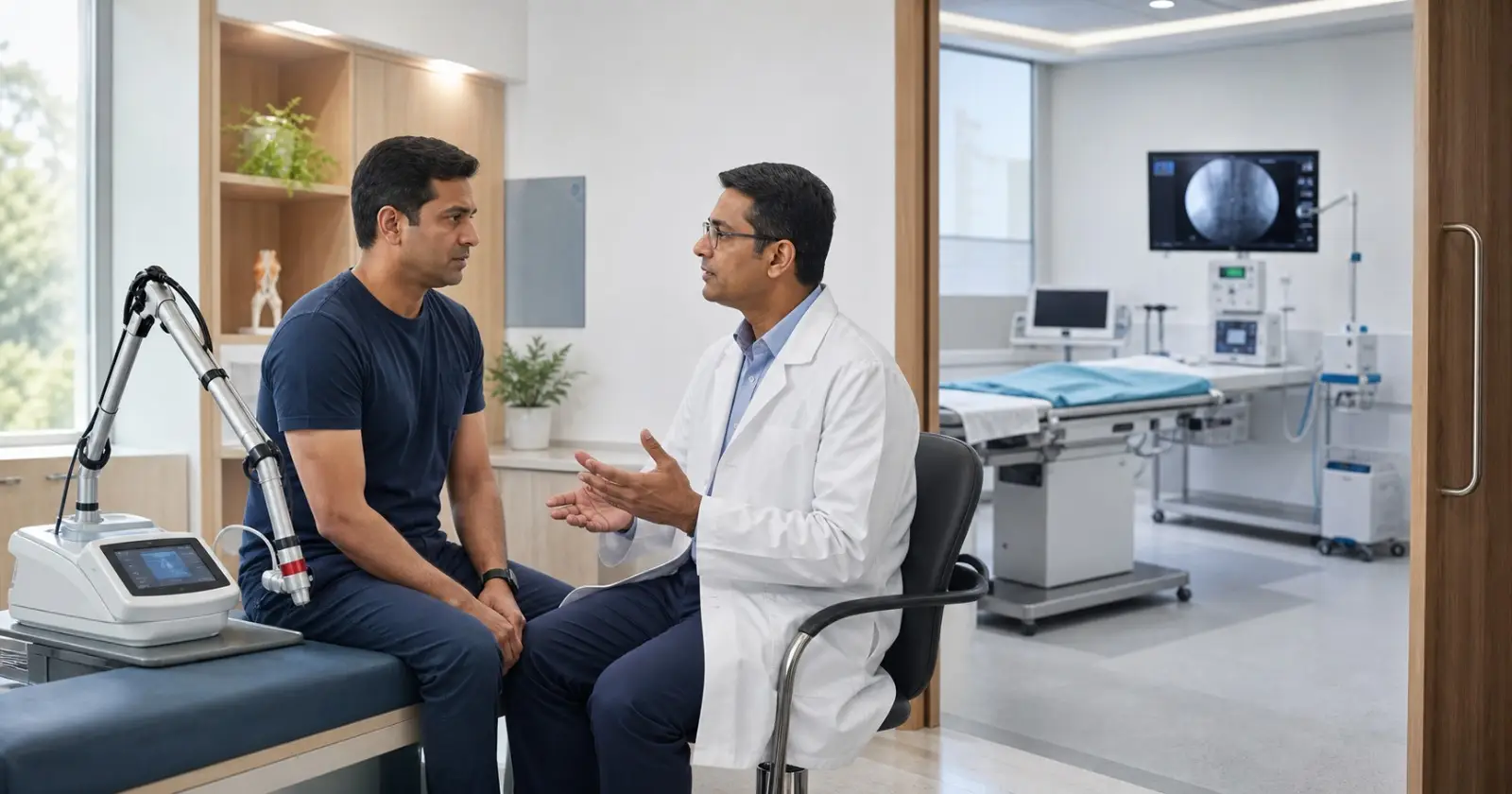
Before recommending either treatment, your doctor will typically review your symptoms and history, examine the affected area, and check whether recent imaging (X-ray or MRI) is available or needed.
This step matters for two reasons: it confirms which treatment actually fits your condition, and it becomes the documentation your insurer will look for if you’re planning to claim coverage. Coming prepared with any prior scans, a list of treatments you’ve already tried, and how long you’ve had the symptoms will make this evaluation faster and more accurate.
Is Laser Therapy Covered by Insurance?
This is one of the most common questions patients ask before booking. The honest answer is: it depends on what your doctor’s report says, not on the treatment name alone.
Across major insurers, one important factor is whether the treating doctor’s report establishes the procedure as medically necessary — not cosmetic or purely elective. A report that simply says “laser treatment for pain” is far weaker than one that documents:
- A specific diagnosis (for example, a confirmed disc herniation on MRI, not just “back pain”)
- That standard conservative treatment — medication, physiotherapy — was tried first and didn’t resolve the problem
- Why the laser-based approach specifically was medically appropriate for this case
- Whether the treatment is being billed as a day-care procedure or requires inpatient admission, and why
In Dr. Mall’s practice, PLDD — as a documented day-care procedure with a clear diagnosis and procedure code — is recognised by major TPAs. A standalone course of surface laser sessions is a different matter: insurers generally treat it the same way they treat physiotherapy — a supportive or wellness treatment rather than a covered medical procedure — so it’s typically an out-of-pocket cost.
If surface laser therapy is what you’re considering, it’s worth planning for that as a self-pay treatment rather than assuming insurance will offset it.
This is general guidance based on how documentation and coverage generally work, not a guarantee of coverage for any individual policy. Confirm your specific plan’s terms with your insurer before treatment.
When Laser Therapy Isn’t the Right Answer
Laser therapy — either form — isn’t the right treatment for every kind of pain, and knowing when to look elsewhere matters as much as understanding the cost. Speak to your doctor promptly, rather than continuing with laser sessions, if you notice:
- Progressive weakness in a leg or arm, rather than just pain
- Loss of bladder or bowel control alongside back pain — this needs immediate medical attention
- Pain that keeps getting worse despite several sessions of treatment
- Numbness that is spreading rather than staying in one area
These are signs the underlying problem may need a different kind of evaluation, not necessarily more sessions of the same treatment. Laser therapy, in either form, is one option among several for managing pain — it works well for the right candidate, and isn’t the answer for every presentation. An honest evaluation upfront saves both time and unnecessary expense.
Getting a Clear Answer for Your Case
The most reliable way to know what laser therapy will cost for your specific condition is a consultation, not a general price list. The right treatment and course length depend entirely on your diagnosis, and no online estimate can account for that.
Dr. Sachin Kumar Mall is an orthopaedic surgeon at Shri Shankara Hospital, New Rajendra Nagar, Raipur. He evaluates each case individually to determine whether surface laser therapy, PLDD, or another approach is the right fit.
Where laser treatment is appropriate, his team also provides the clear clinical documentation that supports an insurance claim.
Book a consultation to discuss your condition and get a clear picture of the treatment and cost path that applies to you.
Call +91-9285122111 or visit Shri Shankara Hospital, Raipur.
How Dr. Mall Decides Whether Laser Treatment Fits
Dr. Mall’s clinical approach follows a simple principle: preserve when possible, replace when necessary, precision always. PLDD reflects that philosophy directly. It’s offered as a way to relieve disc-related pain and avoid open spine surgery, where the case genuinely allows for it — not as a default first step for every patient.
With 18 years of experience across joint preservation, joint replacement, and spine care, Dr. Mall assesses candidacy for laser-based treatment on a case-by-case basis. A patient is never guided toward surface laser sessions or PLDD simply because it’s the treatment on offer.
It’s recommended only when it’s genuinely the right fit for what’s actually causing their pain — and where it isn’t, he’ll say so directly and explain what would work better instead.
Frequently Asked Questions
How much does laser therapy for pain cost?
Cost depends primarily on which treatment you need — a course of surface laser sessions or a one-time PLDD procedure — plus the number of sessions and any imaging required. Because these vary by case, your doctor can give you an accurate estimate only after an in-person evaluation of your specific condition.
Is laser therapy covered by insurance in India?
In Dr. Mall’s practice, PLDD is recognised by major TPAs when documented as medically necessary, with a specific diagnosis and evidence that conservative treatment was tried first. Surface/session-based laser therapy is generally treated as an out-of-pocket expense, similar to physiotherapy. Always confirm your specific policy’s terms directly with your insurer.
Does the cost differ between surface laser sessions and PLDD?
Yes, significantly. Surface laser therapy is billed per session as part of a short course, similar to physiotherapy. PLDD is billed as a day-care procedure, including imaging, anaesthesia, and a short hospital stay — a different cost structure entirely, not just a different price point.
How many sessions of laser therapy are usually needed?
This depends on your specific condition and how you respond to treatment. Surface laser therapy for pain typically involves a short course of sessions over a few weeks, while PLDD is generally a single procedure per affected disc.
Your doctor will outline the expected course during your consultation, and will adjust it based on how you’re responding rather than following a fixed schedule regardless of progress.
What’s the difference between laser therapy and physiotherapy for pain?
Surface laser therapy is often used alongside physiotherapy rather than instead of it — the laser session targets inflammation directly, while physiotherapy builds strength and mobility around the affected area. Many patients do both as part of one treatment plan, and your doctor can advise whether combining them makes sense for your condition.