Search “PRP injection cost” and you’ll find a confusing mix of results — some about hair restoration, some about skin rejuvenation, some about knee and joint pain. PRP (Platelet-Rich Plasma) is used across all of these, but the cost, the procedure, and what you’re actually paying for are different in each case.
This guide is about PRP for joint and orthopaedic pain specifically — knee osteoarthritis, tendon injuries, and similar conditions — not hair or skin treatments.
If you’re also comparing PRP with GFC (Growth Factor Concentrate), you’re not alone — many patients are offered both and aren’t sure how they differ or how that affects cost. This guide covers what genuinely determines the price of either option, and what to expect from insurance, without guessing at a rupee figure that may not apply to your case.
PRP and GFC for Joint Pain: What They Actually Are
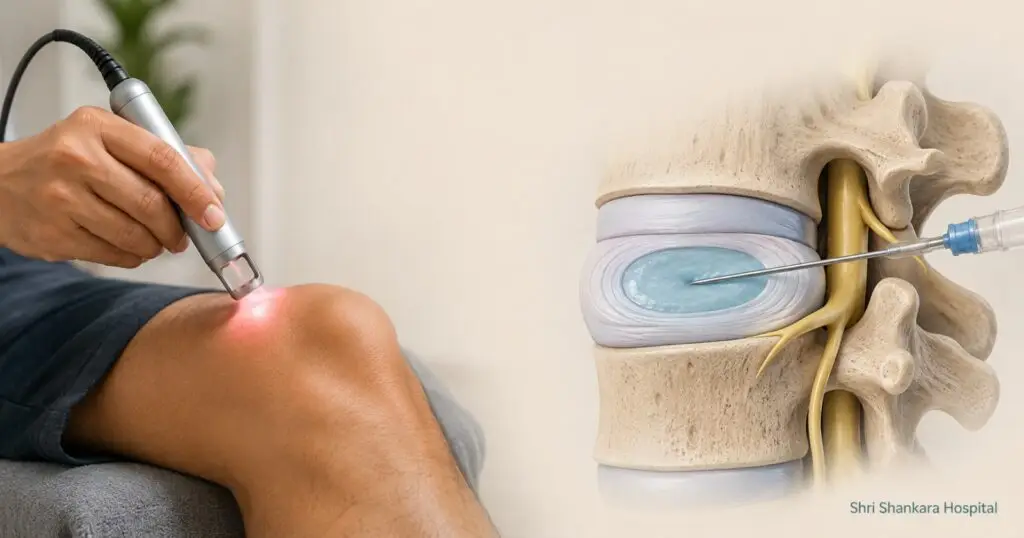
Both PRP and GFC are prepared from your own blood. A small sample is drawn, processed in a centrifuge, and the concentrated portion is injected into the affected joint or treatment area, depending on the condition. The aim is to help manage pain and influence the local healing environment where it’s injected, not to regrow lost cartilage.
They’re closely related treatments prepared from the same starting material, not entirely different categories of care. Neither is a permanent fix or a substitute for surgery where surgery is genuinely needed — they’re a pain-management option that tends to work best for mild-to-moderate joint or soft-tissue wear rather than advanced degeneration.
The practical difference patients notice most is comfort after the injection. GFC processing removes more of the cellular components — such as white and red blood cells — from the sample. This generally means less soreness and swelling in the day or two afterward, compared to standard PRP. Beyond that, the choice between the two often comes down to what your doctor’s assessment recommends for your specific joint and condition, not a fixed rule that applies to everyone.
This article focuses on cost and insurance. For a deeper look at how PRP and GFC compare for knee pain specifically, see our dedicated PRP vs GFC guide.
What Determines PRP Injection Cost
PRP injection cost depends on the number of sessions your treatment plan requires, which joint (or joints) are being treated, whether diagnostic imaging is needed, and whether you’re having PRP or GFC. Here’s how each factor plays out:
1. Number of Injections
This depends on your condition and how you respond to treatment — some patients need a short series of sessions spaced a few weeks apart, others need fewer. The total cost reflects the full course your doctor recommends after assessing you, not one session in isolation.
2. Which Joint, and Whether It’s Bilateral
Treating both knees, for example, means treating two joints rather than one — which affects the total cost differently than a single joint. Ask your doctor to explain how this is priced for your specific case.
3. Diagnostic Imaging
Your doctor may review existing X-rays or recommend imaging where it’s needed to confirm the diagnosis and assess the extent of joint wear. When imaging is required, it’s a separate cost from the injection itself.
4. PRP vs. GFC Processing
GFC involves an additional processing step to remove cellular components before injection. Ask your doctor directly whether this affects the total cost in your specific case, since processing methods and pricing structures vary by clinic.
5. Your Specific Condition
Mild, early-stage joint wear and a more advanced or long-standing injury don’t necessarily call for the same treatment plan or number of sessions. This is why an accurate cost estimate can only come after your doctor has actually assessed your condition, not from a general price list.
What Happens at Your Consultation
Before recommending PRP, GFC, or another treatment, your doctor will typically review your symptoms and history, examine the affected joint, and check whether imaging is needed to confirm the diagnosis. This step matters for two reasons.
It determines whether you’re actually a good candidate for regenerative injections in the first place, and it shapes the specific treatment plan, including how many sessions are likely needed. Coming prepared with any prior scans, a list of treatments you’ve already tried, and how long you’ve had the symptoms will make this evaluation faster and give you a more accurate picture before you leave.
Is PRP or GFC Covered by Insurance?
This is one of the most common questions patients ask before booking, and it’s worth answering honestly upfront: in Dr. Mall’s experience, most TPAs (Third-Party Administrators) do not cover PRP therapy for joint pain.
This isn’t unique to his practice — most patients considering PRP or GFC for joint pain should budget for it as an out-of-pocket treatment rather than assuming insurance will offset the cost.
If you have a specific policy you’d like to check, the most reliable step is to ask your insurer directly whether orthopaedic PRP or GFC injections are covered. Coverage details can vary between insurers and between individual policies, so a general statement about the industry won’t tell you your own plan’s specifics — a direct call is worth the ten minutes it takes.
This is general guidance based on how coverage for these treatments typically works, not a guarantee for any individual policy.
When PRP or GFC Isn’t the Right Treatment
PRP and GFC work best for mild-to-moderate joint wear and certain soft-tissue injuries — they aren’t a fit for every case. Speak to your doctor about other options, rather than pursuing PRP or GFC on your own, if you have:
- Advanced, bone-on-bone joint damage with little cartilage remaining
- An active infection in or near the joint
- A bleeding disorder or are on blood-thinning medication, without your doctor’s clearance
- Pain that hasn’t responded to an initial course of injections — this may signal the joint needs a different approach altogether
An honest assessment of whether you’re a genuine candidate matters more than the treatment’s popularity — it’s not the right option for every kind of joint pain.
Frequently Asked Questions
How much does a PRP injection for the knee cost?
Cost depends primarily on how many injections your treatment plan requires, which joint (or joints) are being treated, and whether imaging is needed beforehand. Because these vary by case, your doctor can give you an accurate estimate only after assessing your specific condition.
Is PRP covered by insurance in India?
In Dr. Mall’s experience, most TPAs do not cover PRP therapy for joint pain. Confirm your specific policy’s terms directly with your insurer, since coverage can vary between insurers and individual plans.
Does GFC cost more than PRP?
GFC involves an extra processing step to remove cellular components from the sample. Ask your doctor directly about whether — and how — this affects cost for your specific case, since this varies by clinic and by treatment plan.
How many PRP or GFC sessions are usually needed?
This varies depending on the condition being treated and how you respond to treatment. Some treatment plans involve a series of injections spaced a few weeks apart; others involve fewer sessions. Your doctor can outline the expected course after assessing the joint and reviewing your progress, rather than committing you to a fixed number upfront.
Is PRP the same as GFC?
They’re closely related — both are prepared from your own blood and work on the same underlying principle of using your body’s own healing factors. GFC processing removes more cellular material, which generally means less post-injection soreness. Your doctor’s assessment of your specific joint and condition determines which is the better fit for you. See our full PRP vs GFC comparison for more detail on how they differ.
Getting a Clear Answer for Your Case
The only reliable way to know your PRP injection cost, or what GFC treatment may cost for your case, is through an individual assessment — not a general price list. The right treatment plan depends on your diagnosis, and no online estimate can substitute for an actual consultation.
Dr. Sachin Kumar Mall is an orthopaedic surgeon at Shri Shankara Hospital, New Rajendra Nagar, Raipur. He treats knee osteoarthritis, tendon injuries, and sports-related joint pain, with PRP and GFC among his regenerative treatment options.
He assesses each case individually to determine whether PRP, GFC, or another approach is the right fit for your condition.
Book a consultation to discuss your condition and get a clear picture of the treatment and cost path that applies to you.
Call +91-9285122111 or visit Shri Shankara Hospital, Raipur.
How Dr. Mall Decides Between PRP and GFC
Dr. Mall’s clinical approach follows a simple principle: preserve when possible, replace when necessary, precision always. PRP and GFC reflect that philosophy directly — both are pain-management options aimed at supporting the joint’s own healing response, offered where the case genuinely supports it rather than as a default first step for every patient walking through the door.
With 18 years of experience in joint preservation, joint replacement, and sports injury care, Dr. Mall assesses candidacy for regenerative injections on a case-by-case basis.
A patient is never guided toward PRP or GFC simply because it’s an available treatment. Where it isn’t the right fit — advanced joint damage, for instance, where regenerative injections are unlikely to help meaningfully — he’ll say so directly. He’ll explain what would work better instead, rather than starting a course of treatment that’s unlikely to succeed.