Types of Laser Therapy for Pain: 2 Kinds, 1 Clear Guide
If you have searched for the types of laser therapy for pain, you have probably met a confusing mix of terms. Low-level laser therapy. Cold laser. Class IV laser. Percutaneous laser disc decompression. Clinic websites often use them as if they mean roughly the same thing.
They do not mean the same thing. These treatments fall into two very different families. One is applied to the surface of your skin. The other is delivered inside the body, through a fine needle, under imaging guidance.
Knowing which family, a clinic is actually offering you matters far more than the brand name on the machine. This article explains both in plain language.
On this page
- Why “laser therapy” confuses so many patients
- What are the main types of laser therapy for pain?
- Where the types of laser therapy for pain fit
- Is laser therapy for pain safe?
- Frequently asked questions
- Getting assessed in Raipur
Why “Laser Therapy” Confuses So Many Patients
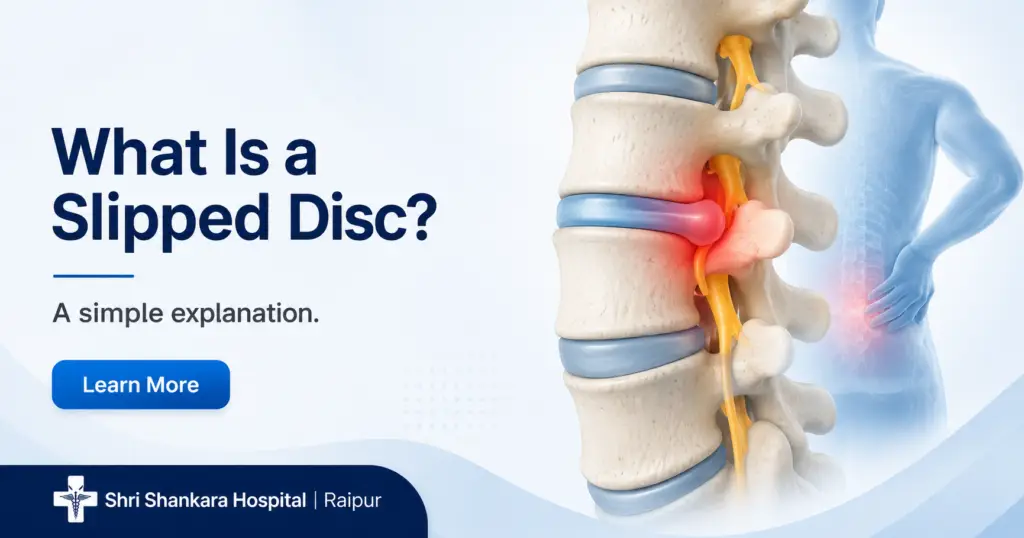
Most people arrive at this topic through a specific problem. Knee pain that will not settle. Back pain that travels down one leg. A slipped disc diagnosis and a strong wish to avoid surgery.
Dr. Mall sees a consistent pattern in how these patients arrive:
“By the time a patient comes asking for laser treatment for the back, they have often already heard that they have a slip disc or disc bulge, and that laser treatment is a simple, scarless alternative to major spine surgery.”
That belief is not entirely wrong. It is just incomplete, and the missing part is the part that matters.
Then the search results arrive, and the language gets slippery. One page describes a painless ten-minute session with a handheld device. Another describes a day-care procedure with a needle and local anaesthesia. Both call it laser treatment.
That is a genuinely confusing starting point. It is also an important one to sort out, because the two are not alternatives to each other. They treat different problems, in different ways, with very different expectations attached.
What Are the Main Types of Laser Therapy for Pain?
The single most useful distinction is whether the laser light stays outside the body or is delivered inside it.
Family one: surface lasers, used as a therapy
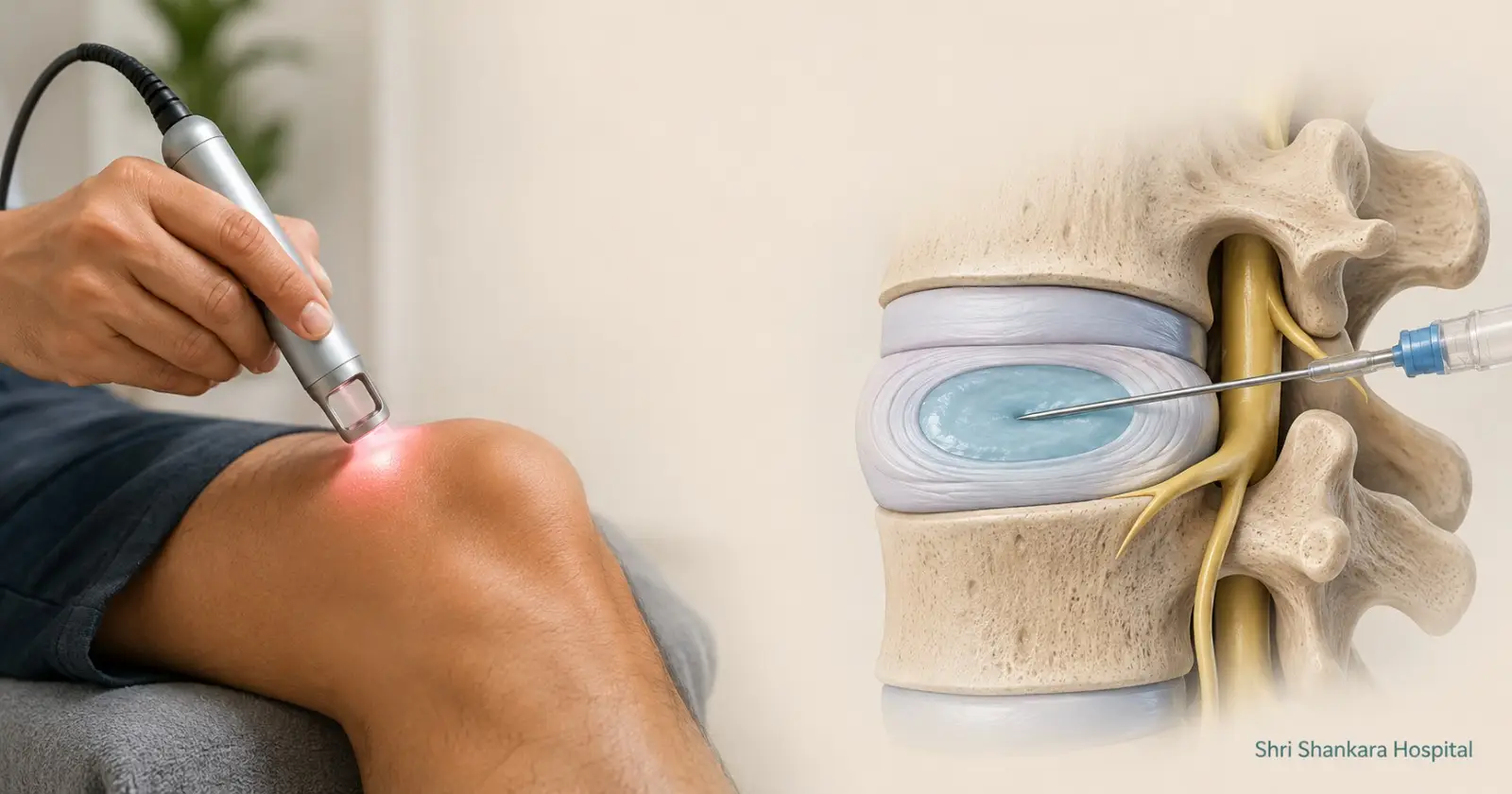
These devices sit on or just above the skin. The light passes through tissue, and the intended effect is on pain and localised inflammation, not on the structure underneath.
- Low-Level Laser Therapy (LLLT), often called cold laser therapy, uses lower-power light. “Cold” only means the treatment does not produce a significant heating effect. The device itself is not cold.
- Class IV laser therapy, sometimes marketed as deep tissue or high-power laser, uses a higher power output. This delivers more energy in a shorter session. How deeply light travels is governed mainly by its wavelength, not its power.
- MLS laser is not a separate power class at all. It describes a delivery method that combines two wavelengths at the same time.
Class I to Class IV is a laser safety classification based on power output. It is not a ranking of clinical effectiveness. A higher class is not automatically the better treatment for your problem.
Surface lasers are non-invasive and quick. They are best understood as supportive treatment, used alongside physiotherapy and a wider plan, rather than as a fix for a structural problem inside a joint or disc.
Family two: interventional laser, used as a procedure
Here the laser is not a therapy applied to the skin. It is a surgical energy source, delivered through a needle, to change something physical inside the body.
The main example in spine care is Percutaneous Laser Disc Decompression (PLDD). A fine needle is placed into the centre of the affected disc under imaging guidance. Controlled laser energy is then applied to a very small volume of the disc’s inner gel.
The point is not to take the disc out. Reducing that small volume is intended to lower the pressure inside the disc, which in turn eases the pressure on the irritated nerve root. That is the mechanism by which the procedure aims to relieve sciatica pain.
This is where the second common misunderstanding sits. Dr. Mall reports hearing it regularly:
“Another common misconception is: ‘Laser will completely remove my disc.’ PLDD does not simply remove the entire disc. A laser is introduced through a fine needle into the affected disc, and controlled energy is used to decompress the disc and reduce pressure related to the disc problem.”
The disc stays. What changes is the pressure inside it.
PLDD is usually performed under local anaesthesia as a day-care procedure. There is no large incision, no bone removal and no implant. It sits between conservative treatment and open spine surgery, not alongside cold laser therapy.
So the word “laser” is genuinely the only thing these two families share. One is a physiotherapy-style modality. The other is a minimally invasive spine procedure.
Treatment Approach: Where the Types of Laser Therapy for Pain Fit
The two families sit in completely different parts of a treatment plan.
Surface laser therapy belongs to the supportive side of care. It may form part of a physiotherapy and pain-management programme for musculoskeletal pain, soft-tissue injury, or recovery support after a procedure. It does not correct a disc that is pressing on a nerve.
Interventional laser belongs to a different pathway altogether: the non-operative treatment of slipped disc and sciatica.
The non-operative disc pathway
For a patient with a slipped disc and sciatica who has not responded to medication, activity modification and physiotherapy, several minimally invasive options exist before open surgery is considered.
- Percutaneous Laser Disc Decompression (PLDD) — laser energy delivered by needle into the disc to reduce internal pressure on the nerve.
- Radiofrequency Nucleoplasty — the same principle of reducing disc pressure, but using radiofrequency energy rather than laser to remove a small volume of disc material.
- Radiofrequency Biacuplasty — cooled radiofrequency applied to the outer wall of the disc, aimed at back pain arising from the disc itself rather than at nerve-compression leg pain.
- Ozone Disc Decompression — an ozone-oxygen mixture injected into the disc, intended to reduce the volume of the protruding material and ease pressure on the nerve.
- Ozone Prolotherapy — an ozone-oxygen mixture injected around the affected structures, used to target inflammation and pain in the surrounding soft tissues.
These are day-care procedures performed through a needle rather than an open incision, usually under local anaesthesia. Because no bone is removed and no incision is made, recovery is typically shorter than after open spine surgery. Your own recovery timeline should be discussed with your surgeon, as it depends on your disc, your symptoms and your general health.
Candidacy matters more than the technology
None of these procedures suits every slipped disc. As a general principle, they are considered for a contained disc bulge where leg pain dominates and the MRI findings match the symptoms.
They are generally not appropriate where a disc fragment has broken free, or where the spinal canal is severely narrowed. They are also unsuitable where the spine is unstable, or where there is significant muscle weakness. In those situations, open surgery may be the safer and more effective choice.
This is the misunderstanding Dr. Mall says he corrects most often:
“The biggest misunderstanding is that ‘laser’ means every back problem can be treated with a laser. That’s not true. I explain to almost every patient that PLDD is not a treatment for every type of back pain. It is a minimally invasive procedure designed for carefully selected patients, particularly when symptoms are coming from a suitable disc problem.”
His assessment runs in a fixed order before the procedure is even discussed:
“Before discussing PLDD, I look at the MRI, symptoms, neurological findings and the exact cause of pain.”
Note what is absent from that list. The patient’s preference for a laser is not one of the four inputs. Neither is the availability of the equipment.
This is why the honest answer to “which laser treatment should I have” is that it depends entirely on your scan and your examination findings. The technology is chosen after the diagnosis, never before it.
What the evidence currently says
Patients deserve a straight answer here, because clinic marketing rarely gives one.
These procedures are well established as techniques, and their safety profile is reasonably understood. Their effectiveness is less settled. Reviewing percutaneous laser disc decompression, NICE noted that evidence on both safety and efficacy was limited in quantity and quality, and advised that patients be told about that uncertainty.
Published work on intradiscal ozone reports encouraging results, but also notes there is still no agreed standard for which patients should be selected or how the injection should be delivered.
This does not make these procedures unreasonable choices. It does mean any clinic promising a guaranteed result is overstating what the evidence supports.
The practical implication for you is simple. Ask what the realistic expectation is in your specific case, and what the plan is if the procedure does not give you the relief you hoped for.
Is Laser Therapy for Pain Safe?
Surface laser therapy performed by a trained professional on properly maintained equipment is generally considered low risk. Protective eyewear is standard, particularly with Class IV devices. Treatment is normally avoided over an active cancer, over the abdomen in pregnancy, and where photosensitivity is a concern.
Tell your clinician if you have a pacemaker or another implanted device, or if you take medication that increases light sensitivity. These are screened for before treatment begins.
Needle-based disc procedures carry a small but real risk of infection, bleeding, nerve irritation or an incomplete response. Your treating doctor should explain these to you directly before you consent.
Some symptoms need urgent assessment rather than any planned treatment. Seek medical care immediately if you develop loss of bladder or bowel control, numbness around the groin or inner thighs, or rapidly worsening weakness in a leg. Fever with severe back pain also needs prompt review.
If pain worsens after a session, or you notice an unusual skin reaction, raise it with your treating doctor rather than continuing.
Frequently Asked Questions
What is low-level laser therapy (LLLT)?
LLLT is a lower-power surface laser treatment, also called cold laser therapy. It is applied to the skin to support pain relief and reduce localised inflammation, without producing a significant heating effect. It is used as a supportive part of a wider treatment plan rather than as a stand-alone cure for a structural problem.
What is cold laser therapy?
Cold laser is simply another name for low-level laser therapy. The word “cold” refers to the absence of a significant heating effect on the tissue, not to the temperature of the device. Patients usually feel nothing at all during a session, and there is no downtime afterwards.
What is the difference between cold laser and Class IV laser therapy?
Both are surface laser treatments applied to the skin. Class IV devices use a higher power output, which allows the light to reach deeper tissue in a shorter session. Cold laser uses lower power over a longer application. The class describes power and safety category, not clinical superiority.
What is percutaneous laser disc decompression (PLDD)?
PLDD is a minimally invasive spine procedure, not a surface therapy. A fine needle is guided into the affected disc, and controlled laser energy is applied to a small amount of the inner disc material. This is intended to lower pressure inside the disc and ease pressure on the compressed nerve. That is what relieves the sciatica pain when the procedure works as intended.
Will laser treatment remove my slipped disc?
No, and this is a common misunderstanding. PLDD does not remove the disc. A laser is introduced through a fine needle into the affected disc, and controlled energy is used to decompress it and reduce the pressure related to the disc problem. The disc remains in place — what changes is the pressure inside it.
Can every back problem be treated with laser?
No. This is the misconception Dr. Mall reports correcting most often. PLDD is designed for carefully selected patients whose symptoms are coming from a suitable disc problem. Back pain has many causes, and several of them will not respond to a disc procedure at all. The MRI, symptoms and neurological findings decide.
Is laser treatment for a slipped disc the same as cold laser therapy?
No. Cold laser therapy is applied to the surface of the skin and supports pain and inflammation. Laser disc decompression is a procedure performed inside the disc through a needle. If a clinic offers you “laser for your slipped disc,” it is worth asking directly which of the two they mean.
Can laser therapy be done at home?
Lower-power consumer devices exist for home use. However, the device class, the treatment protocol and the clinical screening used in a supervised setting are generally different. More importantly, a home device cannot diagnose the cause of your pain. Any persistent pain should be assessed by a clinician first.