PRP vs GFC Therapy: Which One Is Better for Knee Pain?
A Complete Patient Guide by Dr. Sachin Mall
Knee pain can make even simple activities like walking, climbing stairs, or getting up from a chair difficult.
Many patients with early knee arthritis want to avoid surgery and often ask:
“Should I choose PRP or GFC therapy?”
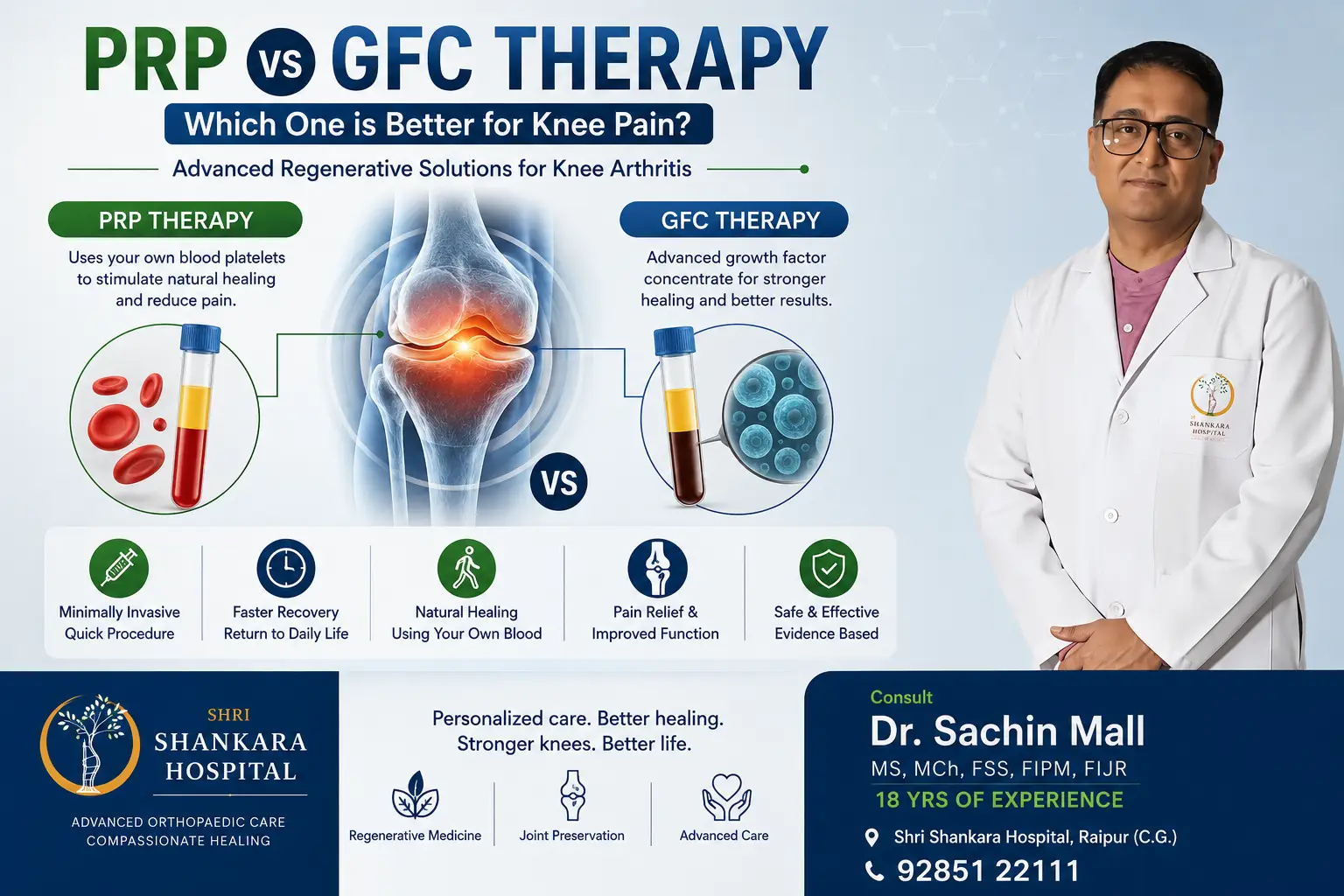
Both Platelet-Rich Plasma (PRP) and Growth Factor Concentrate (GFC) are regenerative medicine treatments that use components derived from your own blood. While both therapies aim to reduce pain and improve function, they are not identical.
At Shri Shankara Hospital, Raipur, Dr. Sachin Mall (MS, MCh, FSS, FIPM, FIJR) offers personalized regenerative treatment plans based on each patient’s condition rather than a one-size-fits-all approach.
What Is PRP Therapy?
Platelet-Rich Plasma (PRP) is prepared from a small sample of the patient’s own blood.
The blood is processed to concentrate platelets, which contain natural growth factors involved in tissue repair and healing.
PRP is commonly used for:
- Early knee osteoarthritis
- Tendon injuries
- Ligament injuries
- Sports injuries
- Tennis elbow
- Plantar fasciitis
The aim of PRP treatment is to help reduce pain and inflammation and improve joint function in appropriately selected patients.
What Is GFC Therapy?
Growth Factor Concentrate (GFC) is an advanced regenerative treatment that also uses the patient’s own blood.
Unlike conventional PRP, GFC focuses on isolating and concentrating specific growth factors released from platelets. These growth factors are then injected into the affected joint under sterile conditions.
GFC may be considered for:
- Early knee arthritis
- Chronic knee pain
- Degenerative joint conditions
- Selected tendon disorders
Suitable For
| PRP | GFC |
|---|---|
| Early arthritis | Early arthritis |
| Sports injuries | Selected chronic degenerative conditions |
| Tendon problems | Selected tendon disorders |
Both treatments are minimally invasive and should be performed by trained professionals using appropriate sterile techniques.
PRP vs GFC: What Is the Difference?
Although both treatments use components derived from the patient’s own blood, their preparation and composition differ.
| Feature | PRP | GFC |
|---|---|---|
| Source | Patient’s own blood | Patient’s own blood |
| Main Component | Concentrated platelets and associated growth factors | Concentrated growth factors |
| Preparation | Blood is processed to concentrate platelets | Blood is processed to prepare a concentrated growth-factor product |
| Procedure | Minimally invasive injection | Minimally invasive injection |
| Recovery | Generally quick | Generally quick |
| Potential Uses | Early arthritis, tendon and sports injuries | Early arthritis and selected chronic degenerative conditions |
The choice between PRP and GFC should be based on the patient’s diagnosis, clinical examination, imaging findings, medical history, and treatment goals.
How Is the Procedure Performed?
The procedure is generally completed within 30–60 minutes.
Step 1: Clinical Evaluation
Dr. Sachin Mall examines your knee, reviews your X-rays or MRI, if required, and determines whether regenerative therapy is appropriate.
Step 2: Blood Collection
A small amount of blood is drawn from your arm.
Step 3: Preparation
The blood is processed using specialized equipment to prepare either PRP or GFC.
Step 4: Injection
The prepared solution is injected into the affected knee using a sterile technique.
In some cases, image guidance may be used to improve injection accuracy.
Step 5: Recovery
Patients are observed briefly and usually return home the same day.
Recovery After PRP or GFC Therapy
Recovery is generally quick, although individual recovery times can vary.
Most patients may be able to:
- Walk on the same day
- Resume office work within 24–48 hours, depending on their condition and doctor’s advice
- Gradually return to exercise based on medical advice
Your doctor may recommend:
- Avoiding strenuous activity for a few days
- Ice application, if needed
- A structured physiotherapy program
- Muscle-strengthening exercises
- Weight management
- Following an individualized rehabilitation plan
Following the recommended rehabilitation plan is important for achieving the best possible outcome.
Success Rates: What Can You Expect?
Both PRP and GFC have shown promising results in selected patients with early knee osteoarthritis.
Studies suggest that these treatments may help improve pain and function for some individuals. However, results vary depending on factors such as:
- Age
- Severity of arthritis
- Body weight
- Activity level
- Overall health
- Rehabilitation and lifestyle factors
Patients may experience:
- Reduced knee pain
- Improved mobility
- Better walking tolerance
- Less stiffness
- Improved quality of life
It is important to understand that neither PRP nor GFC is considered a cure for arthritis, and these treatments do not reliably regenerate lost cartilage in advanced disease.
Who Is an Ideal Candidate?
You may be considered for regenerative treatment if you have:
- Early-stage knee osteoarthritis, such as Grade 1 or Grade 2
- Selected cases of early Grade 3 arthritis
- Mild to moderate knee pain
- An active lifestyle with a desire to remain mobile
- Persistent symptoms despite physiotherapy or medications
- A preference for minimally invasive treatment
A detailed clinical evaluation is necessary to determine whether PRP or GFC is appropriate for you.
Who May Not Benefit?
Regenerative therapy may be less effective or may not be appropriate if you have:
- Advanced Grade 4 bone-on-bone arthritis
- Severe knee deformity
- Complete ligament rupture requiring surgery
- Active joint infection
- Certain blood disorders or other medical conditions
A detailed assessment is essential before deciding on treatment.
Which Is Better: PRP or GFC?
There is no single treatment that is best for every patient.
The right choice depends on:
- Your age
- Severity of arthritis
- Clinical examination
- Imaging findings
- Activity level
- Medical history
- Treatment goals
At Shri Shankara Hospital, Dr. Sachin Mall carefully evaluates each patient before recommending the most appropriate regenerative therapy.
The goal is to choose the treatment that best matches the patient’s individual condition rather than following a one-size-fits-all approach.
Why Choose Shri Shankara Hospital, Raipur?
At Shri Shankara Hospital, we believe in a Joint Preservation First approach.
Our comprehensive orthopaedic care may include:
- Regenerative medicine
- PRP therapy
- GFC therapy
- Advanced pain management
- Physiotherapy and rehabilitation
- Robotic joint replacement when surgery becomes necessary
The goal is to provide personalized, evidence-based care that helps patients regain mobility and improve their quality of life.
About Dr. Sachin Mall
Dr. Sachin Mall, MS, MCh, FSS, FIPM, FIJR, is an Orthopaedic Surgeon with 18 years of experience in:
- Regenerative medicine
- Joint preservation
- Pain management
- Robotic joint replacement
- Sports injury care
He is committed to helping patients receive the most appropriate treatment based on scientific evidence and individual needs.
Frequently Asked Questions
1. Is GFC better than PRP?
Not necessarily. Both therapies have their own potential indications. The best choice depends on your specific diagnosis, examination findings, imaging, and treatment goals.
2. Is the injection painful?
Most patients experience only mild discomfort, and the procedure is generally well tolerated. Your doctor may use appropriate measures to improve comfort during the procedure.
3. How many injections are required?
The number of injections varies depending on your condition and your doctor’s treatment plan.
4. Can these treatments avoid knee replacement?
In selected patients with early arthritis, PRP or GFC may improve symptoms and potentially delay surgery. However, advanced arthritis may require knee replacement when non-surgical treatments no longer provide adequate relief.
5. Are there side effects?
Because these treatments use components derived from your own blood, serious complications are uncommon when performed appropriately. Temporary soreness or swelling at the injection site may occur.
Book Your Consultation
If knee pain is limiting your daily activities, early evaluation can help identify the most appropriate treatment options for your condition.
Dr. Sachin Mall
MS, MCh, FSS, FIPM, FIJR
18 Years of Experience
Shri Shankara Hospital, Raipur
Appointments: +91 92851 22111