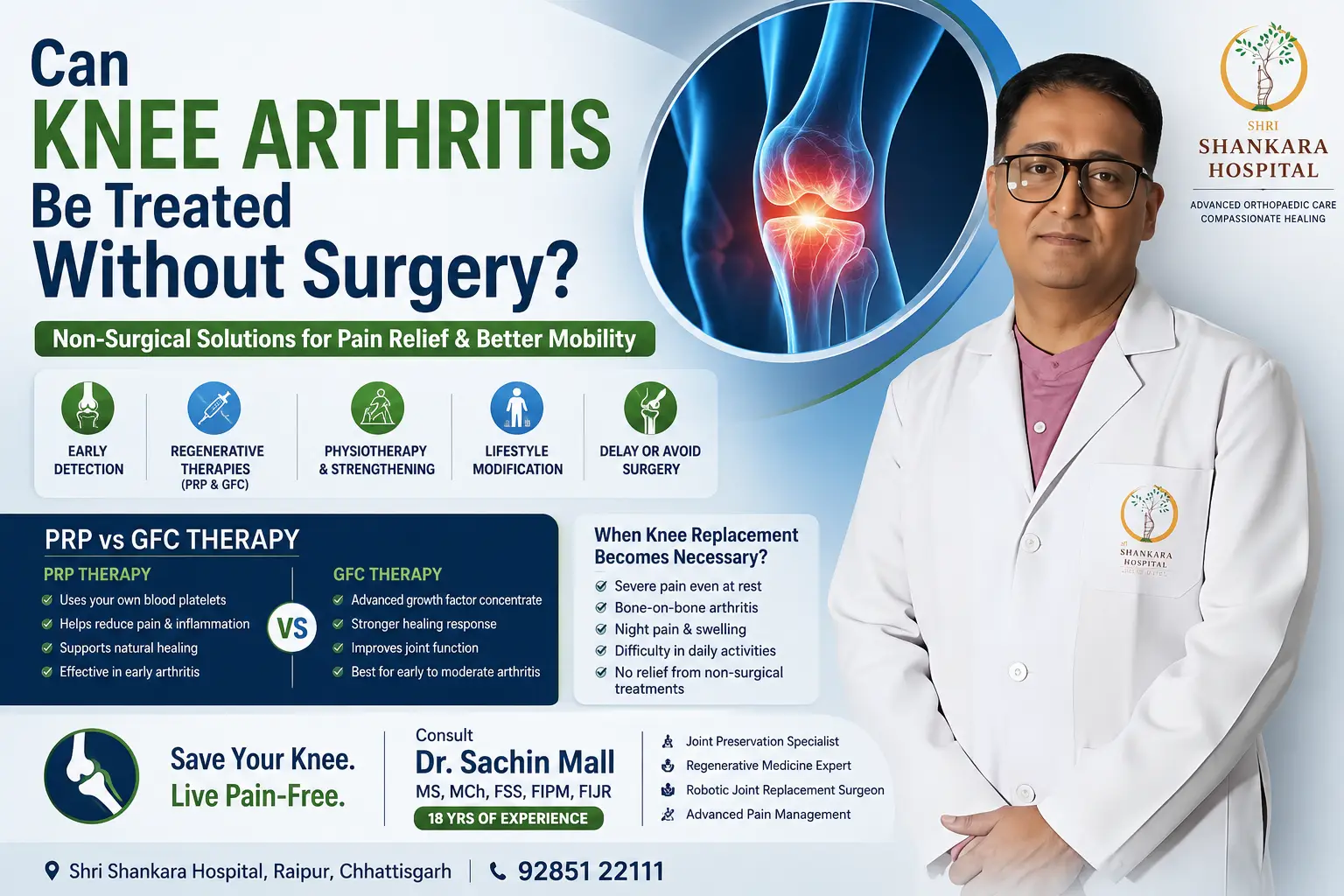
Can Knee Arthritis Be Treated Without Surgery?
A Complete Guide by Dr. Sachin Mall
Knee pain is one of the most common reasons people visit an orthopaedic surgeon. For many patients, the biggest fear is hearing the words, “You need knee replacement surgery.”
The good news is that not every patient with knee arthritis needs surgery.
If arthritis is diagnosed in its early stages, several evidence-based non-surgical treatments can help reduce pain, improve mobility, and maintain an active lifestyle.
At Shri Shankara Hospital, Dr. Sachin Mall follows a joint preservation approach, helping suitable patients manage knee arthritis with personalized non-surgical treatments before considering surgery.
What Is Knee Arthritis?
Knee arthritis, also known as osteoarthritis, is a condition in which the protective cartilage covering the ends of the bones gradually wears away.
As the cartilage becomes thinner, the bones begin rubbing against each other, which can lead to:
- Knee pain
- Swelling
- Morning stiffness
- Difficulty climbing stairs
- Pain while walking
- Reduced flexibility
- Crackling or grinding sounds
- Difficulty sitting cross-legged or squatting
Arthritis usually develops slowly over several years.
What Causes Knee Arthritis?
Several factors can increase the risk of developing knee arthritis, including:
- Increasing age
- Obesity
- Previous knee injury
- Sports injuries
- Family history
- Vitamin D deficiency
- Weak muscles around the knee
- Sedentary lifestyle
- Bow legs or knock knees
Can Knee Arthritis Be Treated Without Surgery?
Yes—but only in carefully selected patients.
Patients with early-stage osteoarthritis, including Grade 1, Grade 2, and some Grade 3 cases, may benefit from non-surgical treatments that help reduce pain and improve function.
The aim is not simply to relieve pain temporarily, but to improve joint function, strengthen supporting muscles, and help patients remain active.
Understanding the Stages of Knee Arthritis
Grade 1 — Very Mild Arthritis
- Very mild cartilage wear
- Occasional pain
- Minimal swelling
- Usually managed without surgery
Grade 2 — Mild Arthritis
- Mild cartilage damage
- Pain during walking or climbing stairs
- Early stiffness
- Often suitable for conservative treatment
Early Grade 3 — Moderate Arthritis
- Moderate cartilage loss
- Frequent pain
- Reduced walking distance
- Some patients may still benefit from regenerative therapies, depending on clinical evaluation
Grade 4 — Severe Arthritis
- Severe cartilage loss
- Bone-on-bone arthritis
- Significant deformity
- Non-surgical treatments usually provide only temporary relief
- Knee replacement may be the most effective long-term option for some patients
Non-Surgical Treatment Options
Treatment is individualized based on factors such as age, activity level, X-ray and MRI findings, body weight, and overall health.
Treatment options may include:
- Lifestyle modification
- Weight reduction
- Physiotherapy
- Muscle-strengthening exercises
- Knee braces
- Activity modification
- Nutritional advice
- Pain-management medications, when appropriate
- Regenerative medicine therapies
PRP Therapy for Knee Arthritis
Platelet-Rich Plasma (PRP) is prepared using the patient’s own blood. Platelets contain natural growth factors that may support tissue healing and help reduce inflammation.
PRP may be considered for:
- Early arthritis
- Sports injuries
- Tendon injuries
- Persistent knee pain in selected patients
Potential Benefits of PRP
- Minimally invasive
- Uses the patient’s own blood
- Short procedure
- May improve pain and function in appropriate patients
- Can be combined with physiotherapy
GFC Therapy for Knee Arthritis
Growth Factor Concentrate (GFC) is an advanced regenerative treatment that provides a concentrated preparation of growth factors obtained from the patient’s blood.
The objective is to support the body’s natural healing response and improve symptoms in selected patients with early degenerative joint disease.
Potential Benefits of GFC
- Higher concentration of growth factors
- Outpatient procedure
- Minimal downtime
- May help improve mobility and reduce pain in suitable patients
PRP vs GFC Therapy
| Feature | PRP | GFC |
|---|---|---|
| Source | Patient’s own blood | Patient’s own blood |
| Growth Factors | Concentrated platelets | Purified growth factor concentrate |
| Procedure | Outpatient | Outpatient |
| Recovery | Usually quick | Usually quick |
| Best Suited For | Early arthritis, tendon injuries | Early arthritis, selected chronic joint conditions |
The choice between PRP and GFC depends on the patient’s condition, examination findings, imaging, and treatment goals.
Your orthopaedic surgeon will recommend the most appropriate option after a detailed evaluation.
Benefits of Non-Surgical Treatment
Patients with early knee arthritis may experience:
- Reduced pain
- Improved mobility
- Better quality of life
- Improved walking ability
- Potential delay in disease progression in some cases
- Reduced dependence on pain medications
- Ability to continue daily activities with greater comfort
Results vary between individuals, and no treatment can guarantee complete cartilage regeneration or permanently stop arthritis progression.
When Does Knee Replacement Become Necessary?
Despite advances in regenerative medicine, knee replacement remains an effective treatment for advanced knee arthritis when conservative treatments are no longer providing adequate relief.
Surgery may be recommended when:
- Bone-on-bone arthritis is present
- Pain occurs even at rest
- Night pain affects sleep
- Walking becomes severely limited
- Daily activities become difficult
- Significant deformity develops
- Multiple non-surgical treatments fail to provide adequate relief
Modern knee replacement surgery can provide significant pain relief and help many patients return to an active lifestyle.
How Dr. Sachin Mall Decides the Right Treatment
At Shri Shankara Hospital, every patient undergoes a comprehensive assessment before treatment recommendations are made.
This may include:
- Clinical examination
- X-rays
- MRI, when required
- Assessment of muscle strength
- Evaluation of joint alignment
- Lifestyle and activity analysis
- Discussion of patient expectations
Based on these findings, a personalized treatment plan is created.
The goal is always to preserve the natural joint whenever medically appropriate and recommend surgery when it offers the best long-term outcome.
Why Choose Dr. Sachin Mall?
Dr. Sachin Mall, MS, MCh, FSS, FIPM, FIJR, is an Orthopaedic Surgeon with 18 years of experience in:
- Joint preservation
- Regenerative medicine
- Pain management
- Robotic joint replacement
- Complex knee disorders
At Shri Shankara Hospital, he combines evidence-based regenerative therapies, advanced diagnostics, rehabilitation, and robotic joint replacement to provide individualized care for every patient.
Frequently Asked Questions
Is PRP better than GFC?
Both treatments have specific indications. The best choice depends on your condition, examination findings, and your orthopaedic surgeon’s evaluation.
Can PRP cure arthritis?
PRP is not considered a cure for arthritis. In selected patients, it may help reduce pain and improve function.
Can GFC regenerate cartilage?
Current evidence does not support complete cartilage regeneration in advanced arthritis. GFC may help improve symptoms and function in carefully selected patients.
How long does the procedure take?
Most regenerative injections are completed within 30–60 minutes and are performed as outpatient procedures.
Can knee arthritis be prevented?
Maintaining a healthy weight, exercising regularly, strengthening the thigh muscles, and treating injuries early may help reduce the risk of knee arthritis.
Conclusion
Knee arthritis does not always mean surgery.
Early diagnosis and timely treatment can help many patients manage pain and maintain mobility without an operation.
If you have persistent knee pain, stiffness, or difficulty walking, consult an orthopaedic specialist early. The sooner arthritis is diagnosed, the more treatment options may be available.
Book Your Consultation
Dr. Sachin Mall
MS, MCh, FSS, FIPM, FIJR
18 Years of Experience
Shri Shankara Hospital
Appointments: +91 92851 22111